
The From Line
Sending, Managing & Monetizing Email


BOING!
That was the sound of your email bouncing.
As a publisher, or anyone involved in email marketing, you might feel there is no worse sound. Except there is. It’s the sound of silence.
It’s the silence of your email never even reaching the recipient’s servers - or reaching the mailbox, and being swiftly and silently escorted to the spam folder by the automatic filters. Because there was no BOING! - you never know.
The percentage of sent emails that actually make it to the inbox (your deliverability rate), is the metric by which email campaigns and email newsletters live or die. It’s not just related to that one email, either. One email campaign with outstandingly bad deliverability (think 40-50% of your emails never made it to their destination) and your future campaigns start with a mark against them.
20732 Hits
The Publisher
Spanfeller Media Group (SMG) is a fast growth media company, headed up by Jim Spanfeller, former CEO of Forbes. The Daily Meal (TDM) was the first site launched by SMG in the early months of 2011. Since then it has proven to be one of the fastest growing content sites ever and the fastest growing site within the food sphere.
The Situation
As an online publisher that is constantly producing content for distribution, The Daily Meal was manually compiling newsletters several times per day to distribute to their subscribers. This was time-consuming, resource intensive, and the furthest thing from automated. There was also no monetization effort in place which left TDM feeling like they were leaving money on the table every single day. Jim Spanfeller created an in-house solution--he assembled two teams: one team to search for automation options for their daily email distribution, and another team to look into monetization opportunities. Little did he know that they could find solutions to both at Gold Lasso.
6053 Hits

As publishers, we’re obsessed with content relevance. However, with audience fragmentation it has become quite the challenge to remain relevant since multiple audiences often exist on a publisher’s list. Although there’s a lot of interest overlap, it’s difficult to hold the interest of an entire audience without losing the attention of a few.
5632 Hits
As published in MediaPost
Native ads are hot! This controversial yet ultra-effective tactic of blending content, advertisement, and placement is heading straight for consumers' inboxes. With a firm hold on the social channel, native ads are quickly making their way to the email channel where they are a natural fit for mobile newsletter formats. Despite the initial success of native ads, many email publishers are fumbling with their implementation and optimization. Here's some help.
Eye Movement
The successful implementation of native ads in email starts with the format of the email message itself. Email formats are now highly influenced by the success of social media on mobile devices. For example, Facebook made a fairly smooth transition from desktop to mobile, as it was able to scale the value of its social stream to a smaller format. The same challenge for email is achieved via adaptive design, compacting all of an email's content into one narrow column. This one -olumn format significantly increases an email's legibility and engagement, especially on mobile devices, by allowing a subscriber's eye to effortlessly scan from left to right while scrolling.
Native Art
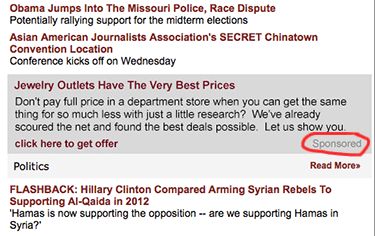
Ideally, all aspects of a native ad's format should be identical to the main content, with the exception of disclosures and labeling. This includes headlines, colors, fonts, image sizes and any other characteristics of the email's native design and format. While some might consider the prior suggestion controversial and even counterintuitive to traditional journalism ethics, others argue that when publishers adopt native ad formats, they send subscribers a message that this content is advertising -- and that their editorial is equally important to their business. After all, you can't have quality content without a solid revenue base to support it. Regardless of your stance, there should be no argument on proper and visible advertising disclosures.
Placement Science
To maximize return on native ads, placement becomes just as critical as format. When using a one-column format, native ad placement in email is easy, yet should be tested extensively while ignoring intuition. An example of letting intuition trump science is not placing a native ad at the top of an email's news stream because an advertisement as a top story goes against the norm. Despite whether this is true or not, publishers who rely on science for placement always fare better then the ones who rely on old-school intuition.
Contextual vs. Personal
Contextual and personal native ads are the two types publishers are currently experimenting with in email. Contextual is easier to implement, as there are fewer targeting and content variables to consider. Personalized content, on the other hand, is much more difficult, since publishers need to be armed with both a deep and diverse ad inventory, as well as with individual targeting capabilities. Unless you are a publisher of a micro-niche subject, it's been proven that personalized native ads mostly outperform contextual ones.
As always, email eventually finds a comfortable role whenever there's a digital media transformation. For now, email is successfully providing extended reach for native ads, while facilitating targeting and testing, resulting in additional publisher revenue.
Elie Ashery is the CEO of Gold Lasso and an adjunct professor at the Robert H. Smith School of Business.
11625 Hits
About This Infographic
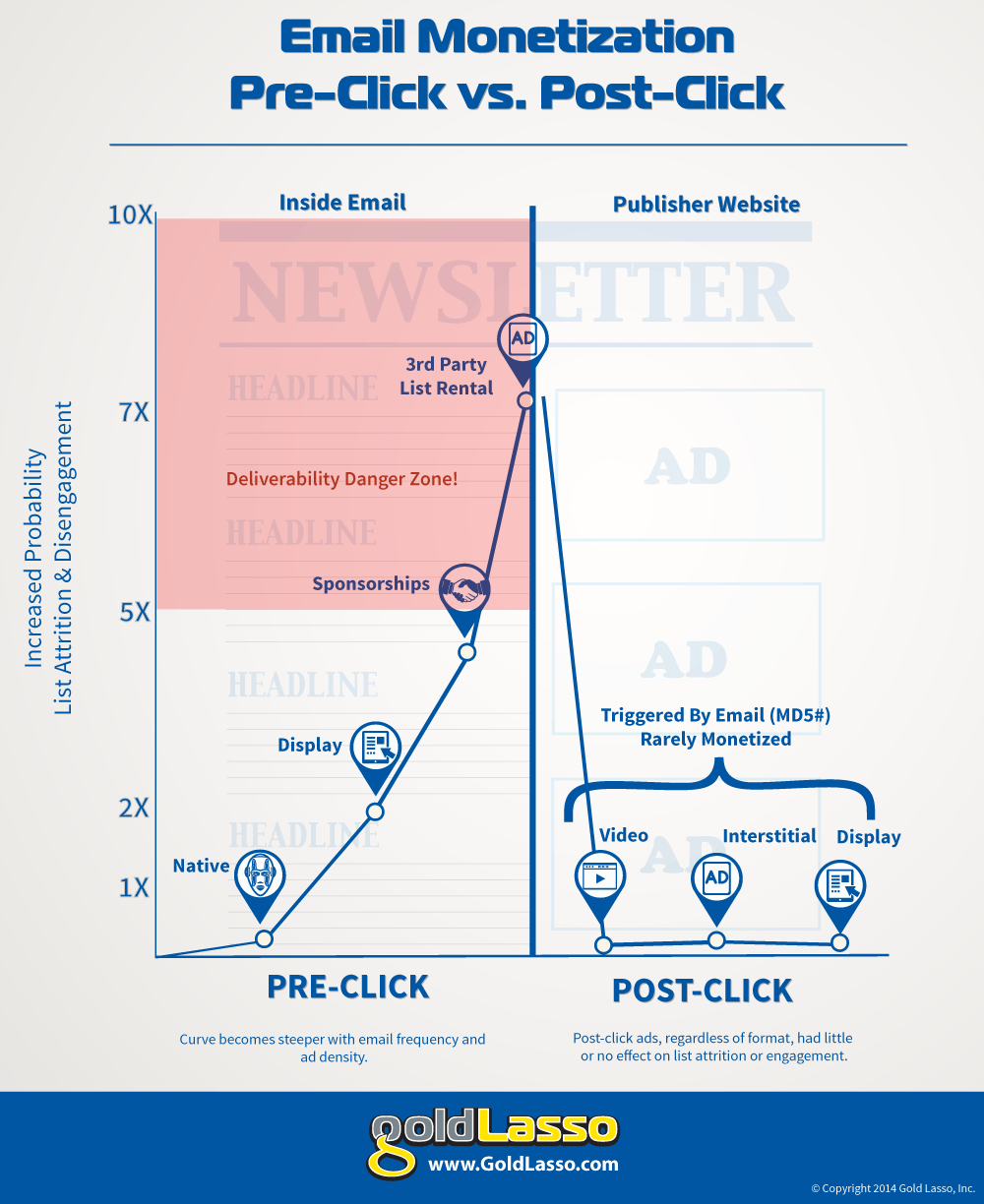
Do different email monetization tactics affect list attrition and engagement differently? This is what our publishing partners wanted know so we decided to study their monetization practices in detail and some of the results were contrary to typical publisher thinking. We wanted to focus our research on a couple of statistics that could easily be measured but reveal what the true risks of various monetization tactics actually are. Therefore, probability of disengagement and opting out was attributed to subscribers who were exposed to various email monetization tactics. This included over 400,000 randomly selected subscribers across 20 publishing partners employing different and overlapping email monetization tactics. Based on our findings, there’s no surprise that pre-click email monetization tactics (monetization inside an email) significantly increased the probability of list attrition and disengagement.
Native advertising, ads placed in the main content column of an email, had the least effect on attrition and disengagement while 3rd party list rentals increased the probability of a subscriber opting-out or ignoring future messages by over 700%. More importantly, despite the high returns of list rentals, they created dire deliverability issues to future email sent. Contrary to common publisher misconception, however, all post-click email monetization tactics (interstitials, videos, display ads, etc.) that leveraged a subscriber’s encrypted email address for targeting purposes, had very little to no effect on list attrition or disengagement. In other words, publishers who don’t leverage subscriber email addresses for post-click targeting and monetization purposes are leaving low risk to no risk money on the table.
Use This Graphic for FREE on Your Site!
You may use the infographic above on your website, however, the license we grant to you requires that you properly and correctly attribute the work to us with a link back to our website by using the following embed code.
Embed Code
<div>
<a href="/images/easyblog_images/63/Newsletter-Monetization-Curve.png" target=
"_blank"><img src="/images/easyblog_images/63/Newsletter-Monetization-Curve.png" alt=
"infographic" width="430" /><br />
Click to Enlarge</a><br />
Via <a href="/blog/entry/354-infographic-post-click-email-monetization-study">Gold Lasso, Subscriber Engagement & Monetization Systems</a>
</div>
Infographic Thumbnail
16787 Hits